Main                

      Research         

      Publication      

      NPRE-470         

      NPRE-498         

      Contacts          

      Archives          


    NPRE-498                                                                                  SP 2027


    Advanced Fuel Cell Science and Engineering


    TBA

    T.R. 14:00 ~ 15:40  (100 min)

    Advanced engineering analysis of fuel cell technologies, focusing on PEMFC, DBFC, MCFC, and SOFC systems. Covers microscopic electrochemical mechanisms, multi-phase transport phenomena, and device-level degradation. Integrates state-of-the-art research through peer-reviewed literature to explore stack design, thermal management, and system integration for stationary and mobile applications. Graduate-level section emphasizes critical synthesis of recent advancements and independent research evaluation through specialized academic presentations.

    Prerequisites: CHEM 102, MATH 285, and PHYS 212. Students are expected to have a basic understanding of thermodynamic principles (e.g., Gibbs free energy, Nernst equation). Completion of ME 200, CHBE 321, or an equivalent thermodynamics course is highly encouraged.


    Recommended Textbook


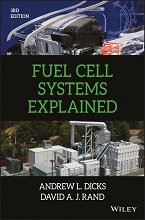
         By Andrew Dicks, David James

          Wiley, 3rd edition (2018)


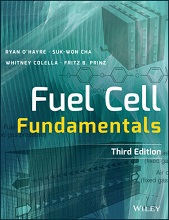
          By Ryan P. O'Hayre, Suk-Won Cha,            Whitney Colella

           Wiley, 3rd edition (2016)

Focus

Engineering-oriented (Systems & Applications)

Science-oriented (Fundamental Principles)

Approach


Top-down approach to 'Operational Systems' (Stack configuration, BoP, Fuel processing, Integration)

Bottom-up approach to 'Physical Foundations' (Electrochemistry, Thermodynamics, Kinetics)


Mathematical Level

Focused on engineering parameter calculations and performance optimization

Focused on deriving equations for fundamental principle proofs

Key Content


"How to actually operate and manage a fuel cell system?"

"What happens inside the fuel cell?"


    Your web connection must be under the 'illinois.net' internet service to download both textbooks. Otherwise, refer to the instructions for using the VPN.


    Unit Converter v.1.1.

    Download and Installation Instructions

    1. Tap the image on the screen to download the Unit_Converter.apk file.

    2. To proceed with installation, please temporarily disable the security option that automatically blocks installation from unknown sources on your Android device.

    3. Depending on your device, Google Play may automatically scan the APK file for potential risks before allowing the installation to complete.


  • Course Syllabus


  • Homework


    Homework grading policy


    All homework must be done by handwriting, and only the readable portions will be evaluated.

    Each homework must be submitted to the Assignments section of the Canvas system.

    Late submissions will be graded as follows:
    90% if one week late, 50% if two weeks late, and 0% if more than two weeks late.


  • Lecture Material


    1.  Orientation; course overview

    2.  Fuel cell components and operating principles

    3.  PEMFC structure and mechanisms

    4.  PEMFC modeling and water management, catalysts, MEA degradation

    5.  PEMFC journal article;  Advancementsin PEM fuel cell technology: evaluating the influence of operating parameters, flow field design, bipolar plate coating, and material factors (Mar. 2025).

    6.  PEMFC journal article;  Advances in proton exchange membrane fuel cell (PEMFC) materials: A review of developments from 2021 to 2025 (Nov. 2025).

    7.  DBFC overview; instructor’s research material

    8.  DBFC electrochemistry; instructor’s research material

    9.  DBFC mechanisms and modeling; instructor’s research material

    10.  DBFC performance and issues; instructor’s research material

    11.  Review session (PEMFC + DBFC)

    Midterm #1


    12.  MCFCstructure and materials

    13.  MCFC chemistry and durability, system integration & applications

    14.  MCFC journal article;  A review on MCFC matrix: State-of-the-art, degradation mechanisms and technological improvements (Feb. 2024)

    15.  MCFC journal article;  Molten carbonate fuel cell and gas turbine hybrid systems as distributed energy resources (Dec. 2011)

    Spring Break — No Class

    16.  SOFC structure & oxygen-ion transport, performance & degradation

    17.  SOFC electrodes & electrolytes

    18.  SOFC journal article;  Progress and outlook of solid oxide fuel cell technology for stationary power generation applications (Sep. 2025)

    19.  SOFC journal article;  Elevating Gas Turbine System Efficiency by Integration with Super-high-temperature Solid Oxide Fuel Cells (Jan. 2025)

    20.  Review session (MCFC + SOFC)

    Midterm # 2


    21.  Comparative fuel cell systems

    22.  Fuel cell research trends

    23.  4-credit Presentation Session I

    24.  4-credit Presentation Session II

    25.  4/22: 4-credit Presentation Session III

    26.  4/22: 4-credit Presentation Session IV

    27.  Course wrap-up; Final review



  • Zoom Midterm Exam

    The midterm exams will be conducted on the Canvas system using Zoom proctoring.

    You may use your own cheat sheet (one sheet only) and must work in your own space (no discussions or Googling allowed), with both Canvas and Zoom active.

    1st exam   TBA

    2nd exam  TBA

    *  This schedule also applies to online students 


  • Research Term Project


    Forthe 4-credit graduate section, students are required to perform a Critical Research Synthesis and Presentation. Graduate students must select a high-impact, peer-reviewed article (published within the last 3 years) that aligns with their specific research area in fuel cells. The task involves not just summarizing but providing a methodological critique and a comparative analysis with current state-of-the-art technologies. This additional work represents approximately 25-30% of the final grade, ensuring the depth and rigor expected at the graduate level.


    Presentation Session I

    Presentation Session II

    Presentation Session III

    Presentation Session IV


Copyright © 2027 Kyu-Jung Kim