|
|
|
ES-470 FA 2026
|
Fuel Cells and Hydrogen Sources
2051 Sidney Lu Mech Engr Bldg
T.R. 15:30 ~ 16:50 (80 min)
The role of hydrogen as a global energy source, its production by nuclear, fossil, and renewable energy sources; hydrogen handling and safety; transportation and storage methods, including high-pressure, cryogenic, metal hydrides, and chemical hydrides; the basic science and technology of fuel cells, including electrochemical processes and fuel cell thermodynamics; low- and high-temperature fuel cells; and applications such as portable electronics, automotive vehicles, distributed and back-up power, and space power.
Prerequisite: CHEM 102, MATH 285, and PHYS 212.
|
|
|
Required Textbook
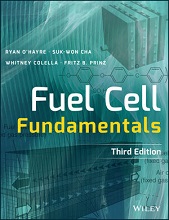
By Ryan P. O'Hayre, Suk-Won Cha, Whitney Colella
Wiley, 3rd edition (2016)
|
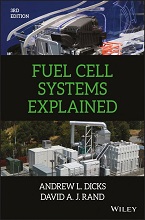
By Andrew Dicks, David James
Wiley, 3rd edition (2018)
|
|
Focus
|
Science-oriented (Fundamental Principles)
|
Engineering-oriented (Systems & Applications)
|
|
Approach
|
Bottom-up approach to 'Physical Foundations' (Electrochemistry, Thermodynamics, Kinetics)
|
Top-down approach to 'Operational Systems' (Stack configuration, BoP, Fuel processing, Integration)
|
|
Mathematical Level
|
Focused on deriving equations for fundamental principle proofs
|
Focused on engineering parameter calculations and performance optimization
|
|
Key Content
|
"What happens inside the fuel cell?"
|
"How to actually operate and manage a fuel cell system?"
|
|
Your web connection must be under the 'illinois.net' internet service to download both textbooks. Otherwise, refer to the instructions for using the VPN.
Unit Converter v.1.1.
Download and Installation Instructions
-
Tap the image on the screen to download the Unit_Converter.apk file.
-
To proceed with installation, please temporarily disable the security option that automatically blocks installation from unknown sources on your Android device.
-
Depending on your device, Google Play may automatically scan the APK file for potential risks before allowing the installation to complete.
Metal Hydride Thermodynamic Cycle Diagram
|
|
Two midterm exams will be administered with Zoom proctoring
You may bring and use one sheet of your own notes (“cheat sheet”) during the exam. The sheet may be double-sided.
Each student will take the exam individually from their own location, using Canvas for the exam itself and Zoom (on a smartphone) for proctoring.
Students must be in a private space with no one else present.
Any form of communication or consultation with others during the exam is strictly prohibited.
1st exam Oct. 1 (Thu), 3:30 PM ~ 4:50 PM, range of lecture 1 - 6
2nd exam Dec. 1 (Tue), 3:30 PM ~ 4:50 PM, range of lecture 7 - 13
* This schedule also applies to online students.
|
|
|
Presentation topic should be related to fuel cells and/or the hydrogen economy.
Teams and team members will be assigned by random draw in Oct. 6 (Tue)
(1) Due - noon, Nov. 3 (Tue). Late registration will result in a 10% of demerit in the final team score.
(2) Elect team leader
(3) Team leaders are requested to ensure all team members agree on the presentation topic and collaboratively draft a 300-word abstract.
(4) Once completed, the team leader should submit the finalized title and abstract to the instructor via email.
Presentation submission due : untill the prior day noon of your presentation
20 min of presentation + 5 min of discussion
Dec. 3 (Thu), 3:30 PM ~ 4:50 PM ----- Team A, B, C
Dec. 8 (Tue), 3:30 PM ~ 4:50 PM ----- Team D, E
7:00 PM ~ 7:20 PM ----- Team ONL
* There will be no additional final exam.
Example; Design your own Fuel Cell
system ;
(1) Field of its application
and engineering requirements
(2) Selection of Fuel, oxidizer
- background of selection and logistics
(3) Electro-chemical reaction
(4) Description of design and structure
(5) Characteristic features compared to other types of power generation or storage
(6) Expected benefit to use the selected system
(7) Conclusion
|
| |
|
|