It is necessary to examine each of these factors above and learn how they contribute to the shape of the system spectrum. We now begin this activity in earnest. The three types of factors are:
K0(jω)n where n is integer-valued.
(jωτ+1)±1
[(ωnjω)2+2ζωnjω+1]±1
For example consider for some constant K the transfer function,
K⋅G(s)=Ks(s2+2s+4)s+3,
where s is the complex frequency variable jω. It can be written as
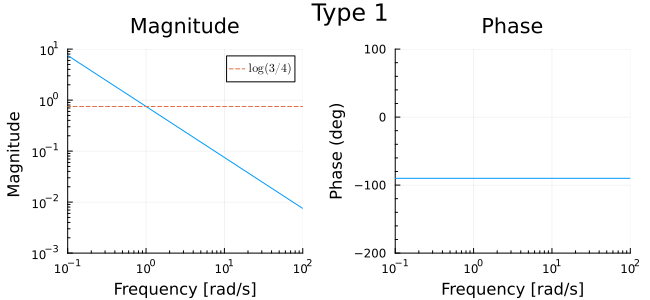
It is a linear function of logω; hence it gives a line of slope n passing through the value log∣K0∣ at ω=1. This line is called a low-frequency asymptote.
In our example above, we had K0(jω)−1. Its magnitude plot is shown in the figure below.
For Type 1 factor, its phase is
∠K0(jω)n=∠(jω)n=n∠jω=n⋅90∘.
The phase is therefore a constant independent of ω.
In our example above, we had K0(jω)−1 . Its phase plot is shown above. In this example the phase is −90∘ for all ω.
To study ∣jωτ+1∣ and ∠(jωτ+1) as a function of ω, we will look at different cases as below:
For ωτ≪1, we have jωτ+1≈1.
For ωτ≫1 we have jωτ+1≈jωτ.In the case, Type 2 factor behaves like Type 1 with K0=τ,n=1
This transition from one extreme to the other can be said to occur at ωτ=1⟺ω=1/τ.This frequency is called the breakpoint frequency.
For the magnitude plot,
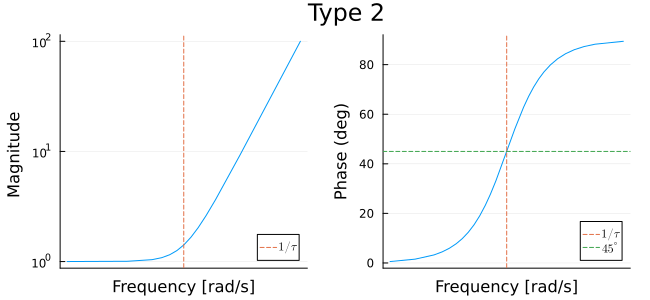
For small ω below the breakpoint, M≈1, a horizontal line.
For large ω above the breakpoint,
logM≈log∣jωτ∣=logωτ=logτ+logω.
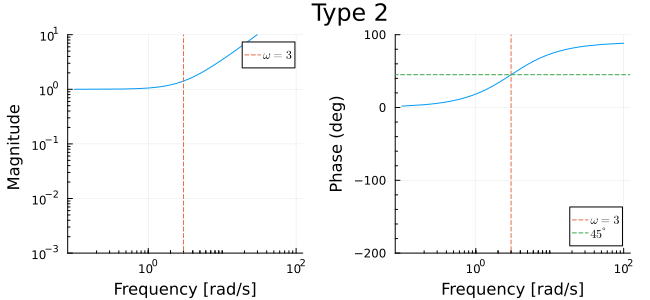
This gives a line of slope 1 passing through the point (1/τ,1) on a plot of log-log scale. Note these are just asymptotes; the actual value of M at ω=1/τ is 2 The figure below shows the magnitude slope "steps up" by 1 at the breakpoint.
As for the phase plot,
For small ω (below breakpoint), ϕ≈0∘.
For large ω (above breakpoint),
ϕ≈∠(jωτ)=90∘.
At breakpoint (ωτ=1),
ϕ=∠(j+1)=45∘.
The figure above shows that the phase "steps up" by 90∘ as we go past the breakpoint.
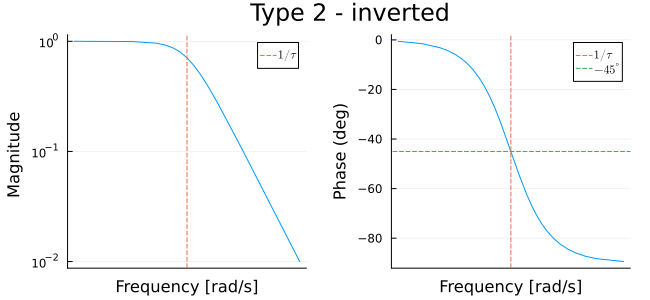
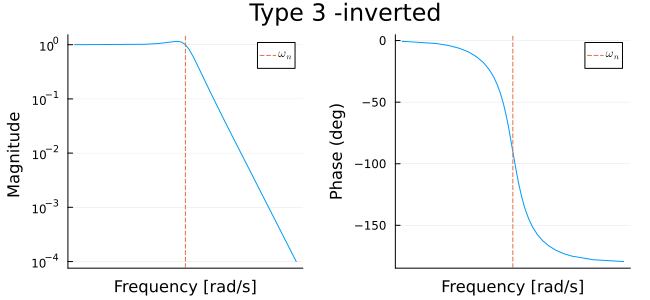
Since this type of factor is the inverse of the one we just discussed, the magnitude and phase plots are reflections of the corresponding plots for the stable real zero with respect to the horizontal axis,
at breakpoint frequency, its magnitude plot “steps down” by 1 in magnitude slope and
Similar to the type 2 case, now the phase and magnitude plots are reflected about the x axis as shown in the plot below.
This brings us to the end of our discussion on creating phase/magnitude plots for the Bode primitives. Next lecture we will do a full fledged example but before that we wrap up the current one with a discussion of resonant frequency.
if we set z:=ωnω as a new variable we can examine the new function M(z). As a function of z, the function M(z) attains a maximum when z=±1−2ζ2.
This means
ω=ωn1−2ζ2
since ωn cannot be negative. Furthermore, we see that there is an extremum for real valued ω only for ζ∈[0,2−1/2]. This
ωr:=ωn1−2ζ2
is called the resonant frequency defined above - a frequency at which bad thingscan happen.
Finally, second order systems are bi-parametric - i.e. while the general shape of the magnitude/phase plots are as discussed above, the exact nature depends on both ωn as well as ζ.
This link allows one to change these parameters to visualize how the plots change.
The Type 1 factor here is 3/4(jω)−1. It has a negative unity exponent and K=3/4. We already showed in the previous lecture what the Type 1 factor for this transfer function will contribute to the Bode plot. These figures are reproduced here for consistency.
For the Type 2 factor in this transfer function, that is,
(3jω+1)
we see that it has a positive unity as exponent and τ=1/3. Thus the magnitude and phase plot for this term are as follows:
The magnitude plot is horizontal until near the breakpoint and then proceeds upwards with slope 1 while the phase plot climbs from 0 to 90∘ by hitting 45∘ at the breakpoint.
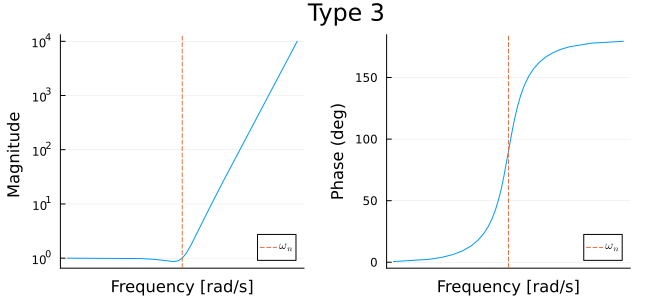
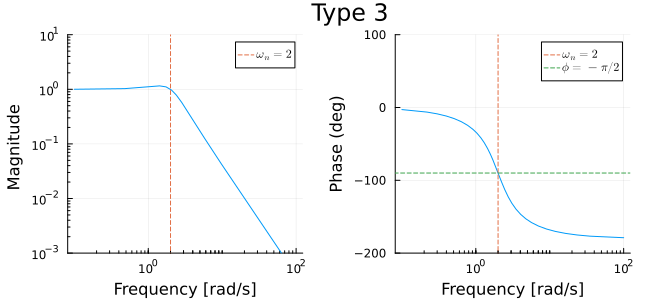
which has negative unity as exponent, ωn=2 and ζ=21. Therefore for the magnitude plot, the graph is horizontal until it reaches near the natural frequency whereupon it descends downwards with slope 2. Similarly the phase plot goes from 0 to −180∘ passing through −90∘ at the natural frequency.
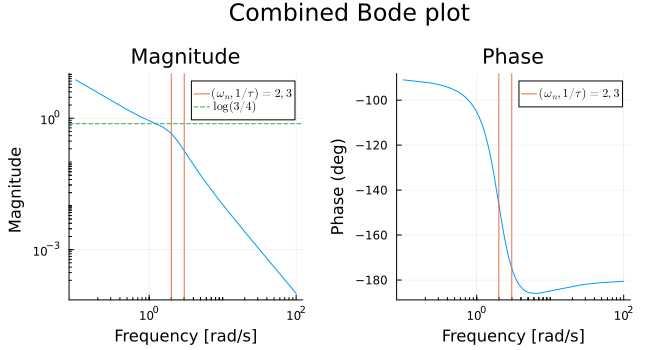
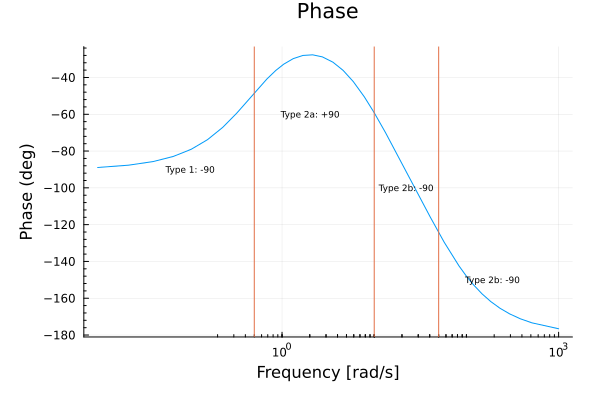
The final plot is a pointwise addition of all the graphs above. For example we know the phase plot will start at −90=−90+0+0 where the terms on the right of the equality are contributions from the Type 1, Type 2 and Type 3 factors. Similarly, we know it will end at −180=−90+90−180. If the breakpoint frequency 1/τ of the Type 2 term and the natural frequency ωn of the Type 3 term where the same, we could have expected the phase plot to cross −135∘=−90∘+45∘−90∘ at this joint frequency. However, ωn<1/τ and so the phase plot crosses −135∘ much earlier.
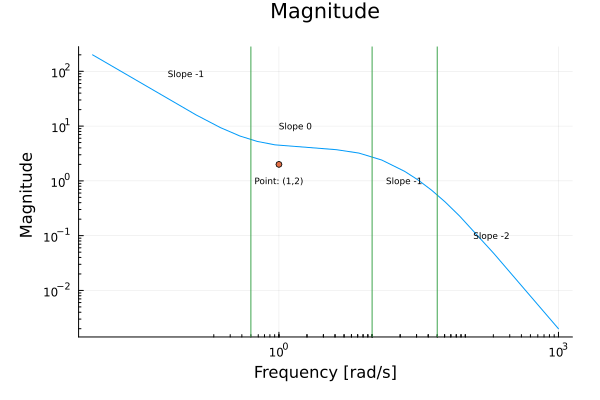
In the same way we can reason about the magnitude plot. We know it will start out with a slope of negative unity. But once the frequency passes beyond the breakpoint/natural frequency, the Type 2 term will add a slope of positive unity; at the same time the Type 3 term will contribute −2 to the slope. So the slope of the graph beyond the breakpoint will be −1+1−2=−2. Therefore the overall plot is two segments of slope -1 and -2 joined around the the breakpoint/natural frequency with a small kink.
This term is jω2. Here K=2 and n=−1. This factor contributes a line of slope −1 passing through (ω,M)=(1,2). Since n=−1 its phase plot starts at −90∘.
Consider the following transfer function which is already in Bode form:
G(s)=s2(64s2+0.028s+1)0.01(s2+0.01s+1).
This transfer function has a single Type 1 factor and two Type 3 factors.
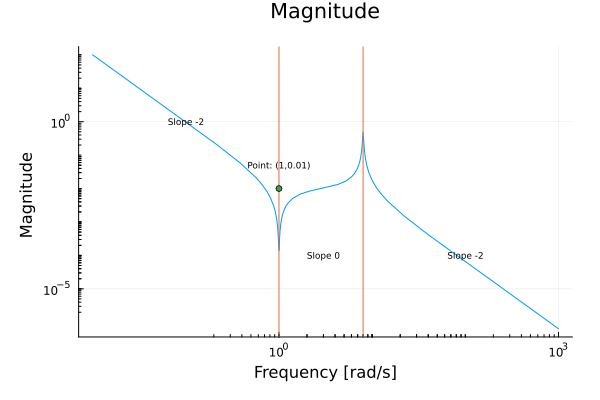
For its magnitude plot we have that,
The Type 1 factor with K=0.01 and n=−2 contributes a line of slope -2 passing through the point (ω,M)=(1,0.01).
The Type 3 factor with positive exponent has natural frequency ωn=1 and damping coefficient ζ=0.005. It contributes a slope increase of 2 beyond ω=ωn along with a resonance dip.
The Type 3 factor with negative exponent has natural frequency ωn=8 and ζ=0.01. It contributes a slope decrease of 2 beyond ω=ωn along with a resonance peak.
For its phase plot we have that,
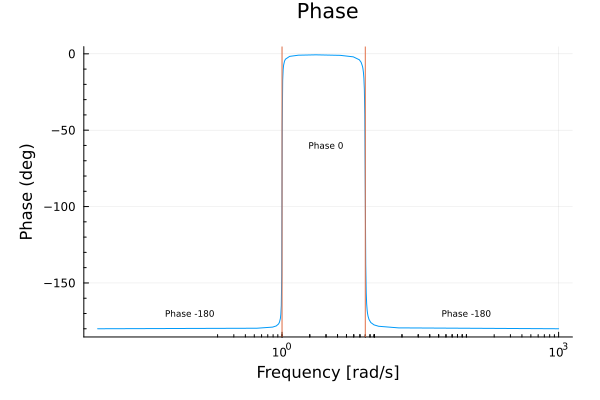
The Type 1 factor has exponent negative 2, therefore the phase plot starts at −2×90∘=180∘.
At ωn=1 the first Type 3 factor contributes a phase increase of 180∘.
At ωn=8 the second Type 3 factor contributes a phase decrease of 180∘.
Since ζ is very small for, both Type 3 factors have sharp transitions.
Note: Some of the following commands/code require the use of the Control System Toolbox in MATLAB; so you might have to use the Engineering Workstations made available by the Grainger College of Engineering.
One can solve for the above examples in MATLAB using the following code.
If you would rather not use MATLAB, then this link points to a notebook that generated the above figures. There is an experimental feature saying it should be runnable in the cloud (click "Run in Binder"); but it is not guaranteed to work.
In this example we make use of the Control System Toolbox in MATLAB while in the next example we will make plots without relying on the toolbox. Recall that the transfer function (2) is:
G(s)=s(s2+2s+4)s+3
The below code generates the final Bode plot.
num=[1, 3];         % Numerator coefficients
den=[1, 2, 4, 0];   % Denominator coefficients
sys = tf(num, den); % Transfer function model
bodeplot(sys);      % Generate bodeplot
title("Final Bode Plot - Example 1")
grid on;
The below code also shows the term by term contributions.
typ1 = tf(3,[4, 0]);		%TF from just Type 1 term
typ2 = tf([1/3, 1], 1);		%TF from just Type 2 term
typ3 = tf(1, [1/4, 1/2, 1]); 	%TF from just Type 3 term

bodeplot(typ1);
hold on
bodeplot(typ2);
bodeplot(typ3);
legend('Type 1', 'Type 2', 'Type 3')