Jiahong Wang — jiahong4
Jialiang Zhang — jz23
Qianlu Chen — qianluc2
Introduction
In this era of digitalization, we rely on computer to do almost everything: from traffic controlling, video conference to writing paper. The brain of a computer is undoubtedly its microprocessor—it is something that all ECE students are required to learn. However, it always sounds a bit intimidating to even just get a taste of such a complex yet fascinating art craft. Microprocessor is complex on both its abstruse theory and its vast numbers of resistors. Moreover, it is often too abstract to understand for many students. So we together with a whole larger group aim to make an 8-bit version of LC3 as a teaching tool to help students visualize and understand the abstract process in a microprocessor. Our group is in charge of the register file part, and here we are going to describe more about its details.
Design
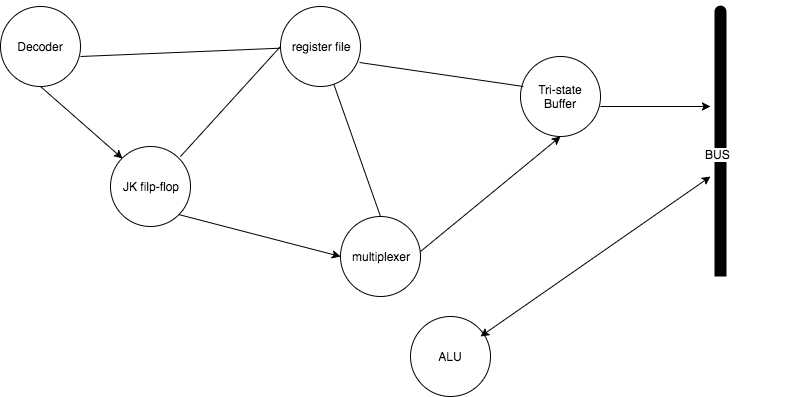
Parts
Wires
Buttons
Breadboard
Different kinds of CMOS chips:
- NOT gate
- AND gate
- OR gate
- NAND gate
- JK flip-flop
- D flip-flop
- Tri state buffer
Challenges
One of the challenges we have is that we have to bring all the sub-units of the project and put them together. Also since the topic we are dealing with will not be covered until later on in the semester, it will also be challenging for us to work ahead on our own to understand the idea. On more technical aspect, circuits may have unexpected errors, especially on breadboard which has weak connections with components pins.
References
- Professor Franke
- Oscar
- http://www.instructables.com/id/How-to-Build-an-8-Bit-Computer/
