Counting Distinct Elements in a Stream
Notes 29 · Full lecture · 75 minutes
CS 574 · University of Illinois, Urbana-Champaign · Fall 2026
Two approaches to distinct counting
First: the minimum of ideal random hash values. Then: bounded samples using pairwise-independent randomness.
| Part | Minutes |
|---|---|
| Model and target | 5 |
| Minimum estimator and its moments | 20 |
| Pairwise sampling at one scale | 20 |
| Amplifying a mixed output | 10 |
| Unknown scale and finite seeds | 15 |
| Guarantees and discussion | 5 |
The object being counted
\[ \sigma=(s_1,\ldots,s_m),\quad s_t\in[n],\qquad S=\{s_t:1\leq t\leq m\}. \] \[ u=|S|=F_0(\sigma). \] Repeated occurrences contribute only once to \(S\).
The approximation guarantee
Given \(0<\varepsilon,\delta<1\), return \(\widehat u\) such that \[ \Pr[(1-\varepsilon)u\leq\widehat u\leq(1+\varepsilon)u]\geq1-\delta. \]
One pass; insertion-only stream; space measured in words. Return \(0\) on an empty stream. For \(n=1\), count exactly with a nonempty flag.
Randomness must be attached to values
A hash function \(h\) assigns one random value to each key. Every occurrence of key \(i\) reuses \(h(i)\).
New randomness at every occurrence would reflect the stream length \(m\). The target here is the number \(u\) of distinct values.
An ideal random function
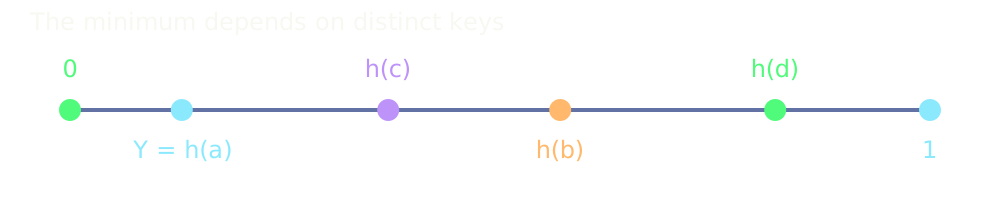
Assume \(h:[n]\to[0,1]\) assigns independent uniform real values to distinct keys. Store \[ Y=\min_{1\leq t\leq m}h(s_t)=\min_{i\in S}h(i). \]
The repeated values disappear automatically under the minimum operation.
First order statistic
For \(u\geq1\), let \[ X_1,\ldots,X_u\overset{\mathrm{iid}}\sim\operatorname{Unif}[0,1], \qquad Y=\min(X_1,\ldots,X_u). \]
Compute the survival probability
For \(0\leq t\leq1\), \[ \begin{aligned} \Pr[Y>t] &=\Pr[X_1>t,\ldots,X_u>t]\\ &=\prod_{i=1}^u\Pr[X_i>t]=(1-t)^u. \end{aligned} \]
Independence is essential to the product.
From survival to density
\[ F_Y(t)=\Pr[Y\leq t]=1-(1-t)^u. \] Differentiate on \((0,1)\): \[ f_Y(t)=u(1-t)^{u-1}. \]
A density is not a point probability. For \(0\leq a\leq b\leq1\), \(\Pr[a\leq Y\leq b]=\int_a^b f_Y(t)\,dt\).
Integrate the tail to get the mean
Since \(0\leq Y\leq1\), \[ Y=\int_0^1\mathbf1[Y>t]\,dt. \] Taking expectations, \[ \mathbb E Y=\int_0^1\Pr[Y>t]\,dt =\int_0^1(1-t)^u\,dt=\frac1{u+1}. \]
Compute the second moment
\[ Y^2=\int_0^1 2t\,\mathbf1[Y>t]\,dt. \] \[ \begin{aligned} \mathbb E Y^2 &=2\int_0^1 t(1-t)^u\,dt\\ &=2\int_0^1(1-z)z^u\,dz\\ &=2\left(\frac1{u+1}-\frac1{u+2}\right) =\frac2{(u+1)(u+2)}. \end{aligned} \]
Subtract the squared mean
\[ \begin{aligned} \operatorname{Var}(Y) &=\frac2{(u+1)(u+2)}-\frac1{(u+1)^2}\\ &=\frac{u}{(u+1)^2(u+2)}. \end{aligned} \]
\[ \boxed{\frac{\operatorname{Var}(Y)}{(\mathbb E Y)^2} =\frac{u}{u+2}<1.} \]
What are we actually estimating?
\[ \mathbb E Y=\frac1{u+1},\qquad \mathbb E Y\neq u. \] First estimate \(\mu=1/(u+1)\) accurately; then invert and subtract \(1\).
The variance-to-mean-square ratio is bounded independently of \(u\).
Recall the averaging step
For independent copies \(Y_1,\ldots,Y_\alpha\), set \[ A=\frac1\alpha\sum_jY_j. \] Then \[ \mathbb E A=\mu,\qquad \operatorname{Var}(A)\leq\frac{\mu^2}{\alpha}. \]
Choose accuracy for the reciprocal
Set \(\eta=\varepsilon/4\) and \(\alpha=\lceil64/\varepsilon^2\rceil\). \[ \Pr[|A-\mu|>\eta\mu] \leq\frac1{\alpha\eta^2}\leq\frac14. \]
Each block needs \(O(\varepsilon^{-2})\) independent minimum sketches.
Recall the median step
Build \(\beta=2\lceil12\ln(1/\delta)\rceil+1\) independent block averages. Let \(Z=\operatorname{median}(A_1,\ldots,A_\beta)\).
If \(G\) counts good blocks, then \(\mathbb E G\geq3\beta/4\) and \[ \Pr[|Z-\mu|>\eta\mu] \leq\Pr[G<\beta/2]\leq e^{-\beta/24}\leq\delta. \]
All sketches fit in one pass
Choose independent ideal functions \(h_{i,j}\). On item \(s_t\), update \[ Y_{i,j}\gets\min\{Y_{i,j},h_{i,j}(s_t)\}. \] At the end, average within blocks and take the median across blocks.
\[ M=\alpha\beta=O\left(\varepsilon^{-2}\log\frac2\delta\right). \]
Convert the estimate back to \(u\)
On the success event, write \[ Z=\frac{1+\theta}{u+1},\qquad |\theta|\leq\varepsilon/4. \] Output \(\widehat u=1/Z-1\). Then \[ \widehat u-u=-\frac{(u+1)\theta}{1+\theta}. \]
Bound the reciprocal error
For \(u\geq1\) and \(0<\varepsilon<1\), \[ \begin{aligned} \frac{|\widehat u-u|}{u} &=\frac{u+1}{u}\frac{|\theta|}{|1+\theta|}\\ &\leq\frac{2|\theta|}{1-|\theta|} \leq\frac{2\varepsilon}{4-\varepsilon}<\varepsilon. \end{aligned} \]
The idealized theorem
Assuming perfectly random real-valued hashes and their stored values cost \(O(1)\) words, \[ \Pr[|\widehat u-u|>\varepsilon u]\leq\delta, \] using \(O(\varepsilon^{-2}\log(2/\delta))\) words in one pass.
The constant-space hash assumption is idealized. We next give an explicit finite-seed construction.
A sample of distinct values
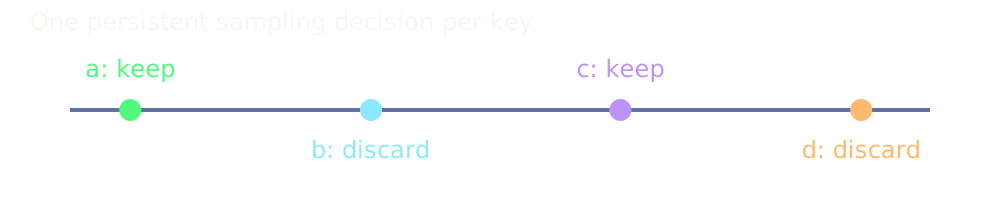
For each \(i\in[n]\), let \(B_i\in\{0,1\}\), with \[ \Pr[B_i=1]=p. \] Assume the bits are pairwise independent and reproducible from a small seed.
Retain the set \(R=\{i\in S:B_i=1\}\).
The update rule
On arrival of \(s_t\), evaluate \(B_{s_t}\). If it is \(1\), insert \(s_t\) into a set \(R\); duplicates do nothing.
The sample size is a sum of indicators
\[ X=|R|=\sum_{i\in S}B_i. \] By linearity, \[ \mathbb E X=\sum_{i\in S}\mathbb E B_i=pu. \]
The sum runs over distinct values, not stream positions.
Pairwise independence is enough for variance
For \(i\neq j\), \[ \operatorname{Cov}(B_i,B_j)=0. \] Therefore \[ \operatorname{Var}(X)=\sum_{i\in S}\operatorname{Var}(B_i) =up(1-p)\leq up. \]
Rescale the sample count
For \(p>0\), let \(\rho=X/p\). Then \[ \mathbb E\rho=u,\qquad \operatorname{Var}(\rho)=\frac{u(1-p)}p. \]
\[ \Pr[|\rho-u|>\varepsilon u] \leq\frac{1-p}{\varepsilon^2pu} \leq\frac1{\varepsilon^2pu}. \]
Why introduce a scale?
Accurate sampling needs \(pu\) on the order of \(\varepsilon^{-2}\). But \(u\) is the unknown target.
First solve a promised problem: given a scale \(N\) with \(u>N/4\), return an estimate or a valid declaration that \(u>2N\).
A precise one-scale contract
Given \(0<\varepsilon<1/4\) and \(u>N/4\), output one of:
- The declaration large: \(u>2N\).
- A number \(\rho\in[(1-\varepsilon)u,(1+\varepsilon)u]\).
The output is correct with probability at least \(7/8\).
Both output types can be correct when \(u>2N\).
Set the probability and memory cap
In the ideal sampling calculation, choose \[ p=\min\left\{1,\frac{32}{N\varepsilon^2}\right\}, \qquad T=pN. \] Keep distinct sampled keys until \(|R|>8T\).
The minimum with \(1\) is necessary at small scales.
The one-scale algorithm
- Maintain the sampled set \(R\).
- If its size exceeds \(8T\), output large and discard this copy’s set.
- If no overflow occurs, output \(\rho=|R|/p\) at the end.
The maximum stored size is \(\lfloor8T\rfloor+1=O(\varepsilon^{-2})\).
Analyze the exact branch first
If \(p=1\), then \(N\leq32/\varepsilon^2\) and \(R\) contains every distinct key seen.
No overflow: return \(|R|=u\) exactly.
Overflow: more than \(8N\) distinct keys appeared, so \(u>8N>2N\).
Both outputs are correct deterministically.
Analyze the sampling branch
Suppose \(p=32/(N\varepsilon^2)<1\) and \(u>N/4\). Then \[ pu>\frac{32}{N\varepsilon^2}\frac N4=\frac8{\varepsilon^2}. \]
\[ \Pr[|X-pu|>\varepsilon pu] \leq\frac{\operatorname{Var}(X)}{\varepsilon^2p^2u^2} \leq\frac1{\varepsilon^2pu}<\frac18. \]
Use one success event for both output types
Let \(X\) be the size of the final conceptual sample, even if storage stopped at overflow. Define \[ \mathcal G=\{|X-pu|\leq\varepsilon pu\}. \] Then \(\Pr[\mathcal G]\geq7/8\).
On \(\mathcal G\), prove correctness separately for a number and for large.
A numerical output is accurate
If there was no overflow, the stored set is the full conceptual sample. On \(\mathcal G\), \[ (1-\varepsilon)pu\leq X\leq(1+\varepsilon)pu. \] Divide by \(p\): \[ (1-\varepsilon)u\leq\rho\leq(1+\varepsilon)u. \]
An overflow declaration is valid
Samples grow monotonically, so overflow implies \(X>8pN\). On \(\mathcal G\), \(X\leq(1+\varepsilon)pu\). Thus \[ u\geq\frac X{(1+\varepsilon)p} >\frac{8N}{1+\varepsilon}>2N. \]
This is an unconditional success proof. We do not condition the probability bound on observing overflow.
One-scale lemma proved
Under \(u>N/4\), the capped sampler uses \(O(\varepsilon^{-2})\) words and returns a correct output with probability at least \(7/8\).
Small scale: exact counting until overflow.
Larger scale: pairwise sampling, rescaling, and Chebyshev.
Independent repetitions at one scale
Run \(r\) independent copies, each with its own seed and bounded sampled set. Each output is either a number or large.
The amplification rule must handle both types of output.
Aggregate the mixed outputs
- If at least half the copies say large, return large.
- Otherwise, return the median of the numerical outputs.
For the proof, we will ensure fewer than \(r/4\) copies are incorrect.
Define a bad copy by its output
A copy is bad if it gives a false declaration or an inaccurate number. \[ B=\sum_{j=1}^r\mathbf1[\text{copy }j\text{ is bad}], \qquad \Pr[\text{copy }j\text{ bad}]\leq1/8. \] The indicators are independent across copies.
Bound the bad-copy tail
Using Markov on \(2^B\), \[ \Pr[B\geq r/4]\leq2^{-r/4}\mathbb E[2^B] \leq\left(\frac{9/8}{2^{1/4}}\right)^r. \] Since \(\ln(9/8)-(\ln2)/4<-1/24\), \[ \Pr[B\geq r/4]\leq e^{-r/24}. \]
A majority declaration contains a correct witness
Suppose \(B<r/4\) and at least \(r/2\) copies say large. At least one of those declarations is correct. \[ \text{Correct declaration}\ \Longrightarrow\ u>2N. \] So the aggregate declaration is correct.
The numerical median has a good majority
Otherwise, the number \(q\) of numerical outputs satisfies \(q>r/2\). At most \(B<r/4<q/2\) of them are bad.
More than half of the numerical outputs lie in \([(1-\varepsilon)u,(1+\varepsilon)u]\). Their median lies there too.
Amplified one-scale lemma
For a failure budget \(0<\eta<1\), choose \[ r=\lceil24\ln(2/\eta)\rceil. \] Then the aggregate output is correct with probability at least \(1-\eta\), using \[ O\left(\varepsilon^{-2}\log\frac2\eta\right)\text{ words}. \]
Implement the bits with a finite seed
Choose a prime \(n\leq Q<2n\) for \(n\geq2\). Choose independent uniform \(a,b\in\mathbb F_Q\) and define \[ h(i)=a(i-1)+b\pmod Q. \]
Two field elements specify a pairwise-independent hash function.
Why the affine hash is pairwise independent
For distinct keys \(i,j\) and prescribed outputs \(x,y\), \[ a(i-1)+b=x,\qquad a(j-1)+b=y\pmod Q. \] Subtracting gives a unique \(a\) because \(i-j\neq0\) in the field; then \(b\) is unique. \[ \Pr[h(i)=x,h(j)=y]=Q^{-2}. \]
Round the sampling probability upward
\[ p_0=\min\{1,32/(N\varepsilon^2)\},\qquad K=\lceil Qp_0\rceil. \] \[ B_i=\mathbf1[h(i)<K],\qquad p'=K/Q\geq p_0. \]
Use the actual probability \(p'\) in both \(T=p'N\) and \(\rho=|R|/p'\).
Rounding preserves concentration
If \(p_0<1\) and \(u>N/4\), \[ p'u\geq p_0u>8/\varepsilon^2. \] Therefore the same Chebyshev bound applies.
If \(p'=1\), the sample is exact. Its size is still capped, so the exact/overflow proof applies.
Rounding preserves the space bound
For \(p_0<1\), \[ T=p'N\leq\frac{32}{\varepsilon^2}+\frac NQ. \] At the dyadic scales used below, \(N<2n\) and \(Q\geq n\), so \[ T<\frac{32}{\varepsilon^2}+2. \]
The sample cap is \(O(\varepsilon^{-2})\); the seed and threshold use \(O(1)\) words.
Cover the possible scales
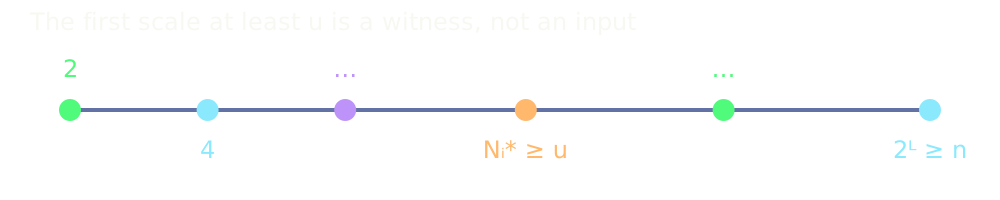
For \(n\geq2\), define \[ L=\lceil\log_2 n\rceil,\qquad N_i=2^i\quad(1\leq i\leq L). \] Run an amplified sampler at every scale in parallel.
Share the failure budget across levels
Give each level failure budget \(\eta=\delta/L\). Its space is \[ O\left(\varepsilon^{-2}\log\frac{2L}{\delta}\right). \]
Across all \(L\) levels: \[ O\left(\varepsilon^{-2}L\log\frac{2L}{\delta}\right)\text{ words}. \]
Select the first numerical output
After the stream ends, inspect levels in increasing order. Skip large declarations and return the first number.
We must prove that a numerical output exists before leaving the range where the one-scale promise holds.
Choose a witness level for the proof
For \(u\geq1\), let \[ i_* = \min\{i:N_i\geq u\}. \] This exists since \(N_L\geq n\geq u\). \[ u\leq N_{i_*}\leq2u. \]
Every earlier level satisfies its promise
For every \(j\leq i_*\), \[ N_j\leq N_{i_*}\leq2u, \qquad N_j/4\leq u/2<u. \] Thus the one-scale guarantee applies to every level we need.
Levels beyond \(i_*\) need not satisfy the promise, and their outputs are irrelevant.
Union bound only over valid levels
Each level through \(i_*\) is wrong with probability at most \(\delta/L\). \[ \Pr[\text{some level }j\leq i_*\text{ is wrong}] \leq i_*\delta/L\leq\delta. \]
Cross-level independence is unnecessary for this union bound. Independence is required among the repetitions within each level.
The witness forces a numerical output
On the event that all levels through \(i_*\) are correct, level \(i_*\) cannot return large: \[ u\leq N_{i_*}\quad\Longrightarrow\quad u>2N_{i_*}\text{ is false}. \] It must return an accurate number. Any earlier number is also accurate.
Complete the scale-selection proof
The first numerical output occurs at some \(j\leq i_*\). On the simultaneous success event, \[ (1-\varepsilon)u\leq\widehat u\leq(1+\varepsilon)u. \] Hence \[ \Pr[|\widehat u-u|>\varepsilon u]\leq\delta. \]
Distinct-count theorem with finite seeds
For \(n\geq2\), \(0<\varepsilon<1/4\), and \(0<\delta<1\), a one-pass algorithm uses \[ O\left(\varepsilon^{-2}\log n\, \log\frac{2\lceil\log_2 n\rceil}{\delta}\right)\text{ words} \] and returns a \((1\pm\varepsilon)\) estimate of \(F_0\) with probability at least \(1-\delta\).
Use exact handling for the empty stream and for \(n=1\). For larger requested \(\varepsilon\), run with \(\min\{\varepsilon,1/8\}\).
The high-probability form in the notes
Fix any constant \(a>0\) and take \(\delta=n^{-a}\). Then \[ L=O(\log n),\qquad \log(2L/\delta)=O(\log n). \]
\[ \boxed{O(\varepsilon^{-2}\log^2n)\text{ words}, \qquad\Pr[\text{success}]\geq1-n^{-a}.} \]
Keep the two randomness models distinct
| Method | Randomness | Space |
|---|---|---|
| Minimum + average + median | Ideal fully random real hashes | \(O(\varepsilon^{-2}\log(2/\delta))\) ideal words |
| Capped sampling at dyadic scales | Finite pairwise hash seeds | \(O(\varepsilon^{-2}L\log(2L/\delta))\) words |
Both ignore repeated keys consistently; the second has an explicit small seed.
Reconstruct the argument
- Why does a minimum estimate \(1/(u+1)\)?
- Why is pairwise independence enough for the sampling bound?
- Why does amplification use fewer than a quarter bad copies?
- Which scale ensures that the first numerical answer is trustworthy?
Source and references
Based on Notes 29, Approximating the Number of Distinct Elements in a Stream.
Prerequisites: median estimation from Notes 28, Chebyshev’s inequality, Chernoff amplification, and polynomial hashing. Background cited in the notes: (Motwani & Raghavan, 1995).
CS 574 · Distinct counting