XXX X X |
Dies completely |
XX X X XX |
Doesn't change |
X XXX X |
Oscillates
(after a few moves) |
X X XX X |
Glider (moves across board) |
See the Wikipedia page for more patterns.
Glider Gun
The "glider gun", created by Bill Gosper,
generates an increasing sequence of gliders.
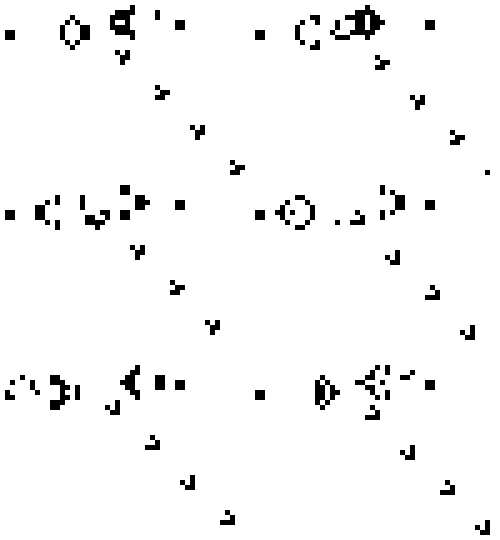
As it runs, the glider gun moves through an infinite sequence of states, never looping back to the same state.
Life pattern behaviors
So, depending on the input configuration, the Game of Life does one of three things:
- "Halts": It stops changing after a while.
- "Repeats": It gets into a repeating loop after a while.
- "Aperiodic": The configuration keeps changing but it's not returning to the same configuration.
It is possible to simulate a simple computer using the Game of Life.
Periodic tilings
Consider covering the plane with a finite set of tiles.
A "periodic tiling" covers the plane
with a regular repeating pattern, using either a single
shape or a finite set of shapes.
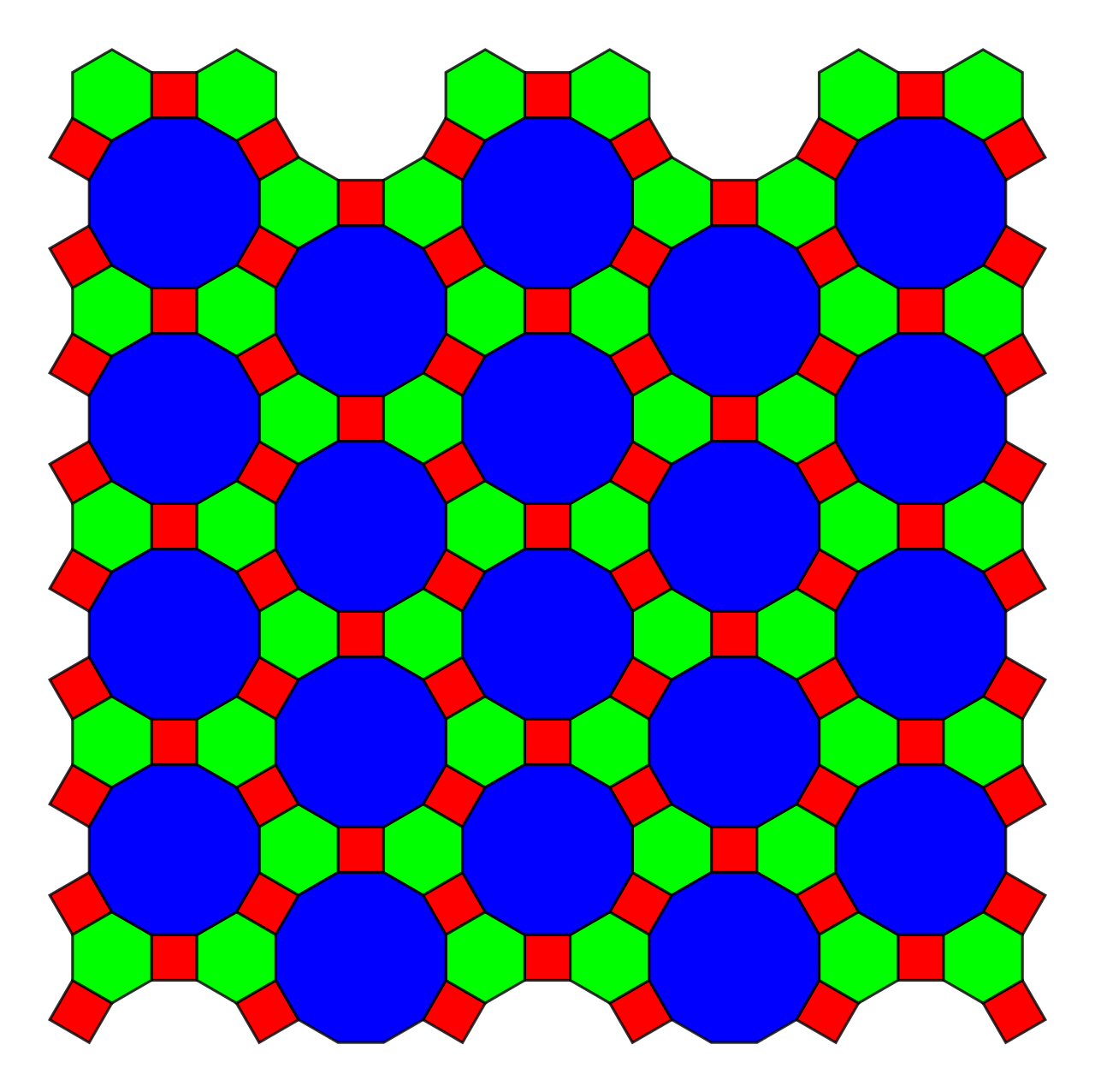
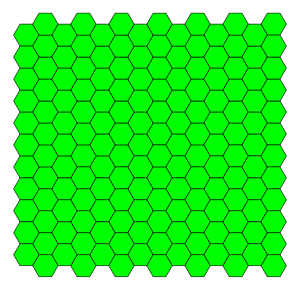
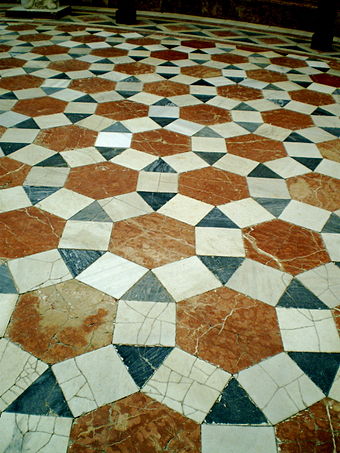
If you cut out a rectangle of appropriate size, you
can make the whole pattern by making copies of whatever is on the rectangle.
This is how modern builders often use cheap materials to simulate the look
of fancy ceramic tiles.
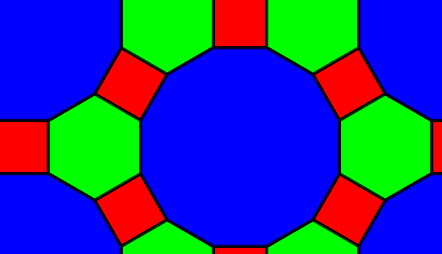
Patterns that stop
A regular pentagon can't tile the whole plane. If you
try to do so, you get stuck with a gap that you can't fill.
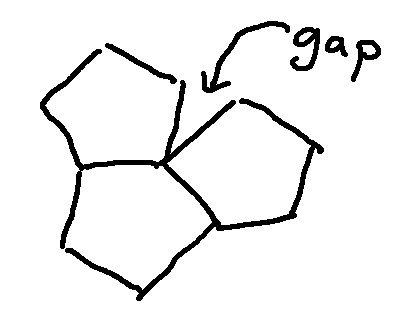
We've now seen two of our three program behaviors: repeating and self-stopping patterns. Are there tiling patterns that continue forever without repeating?
Aperiodic tilings
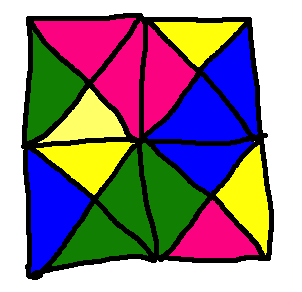
A set of tiles is called "aperiodic" if it can cover the whole plane but not in a regularly
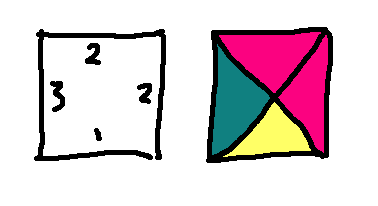
repeating way. The first such construction used "Wang tiles", i.e.
square tiles with labels or colors on their edges.
Wang tiles must be placed so that adjacent edges have the same label/color.
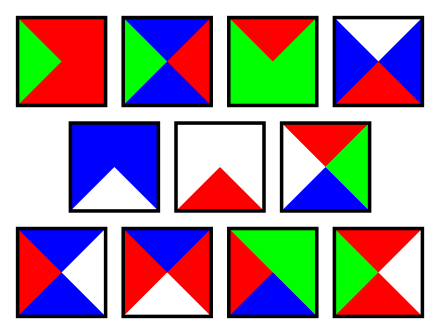
Timeline for Wang tiles
- 1961: Hao Wang defines the problem.
- 1966: Robert Berger finds a set of 20,426 tiles that is aperiodic
- 2015: Emmanuel Jeandel and Michael Rao and a computer reduce this to 11 tiles.
In 1971 Raphael Robinson showed that it was possible to simulate a Turing Machine using Wang tiles.
Pretty aperiodic tilings
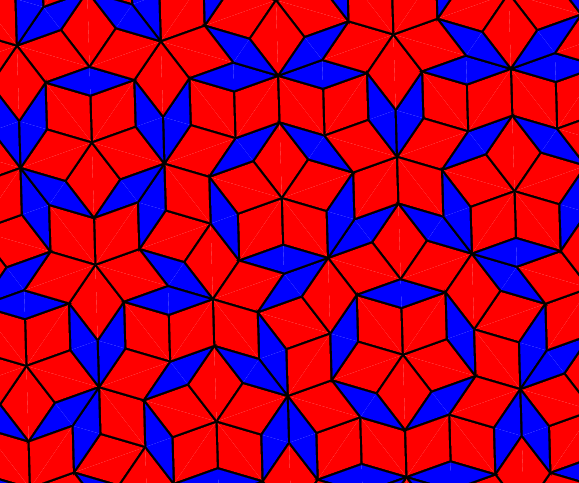
Around 1973-74, Roger Penrose figured out how to make
pretty aperiodic tilings using small sets of geometric shapes.
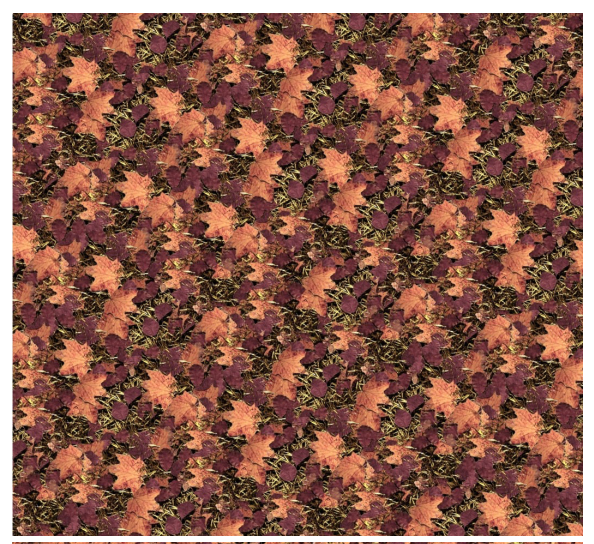
At SIGGRAPH in 2003, a group of graphics researchers
(Michael F. Cohen, Jonathan Shade, Stefan Hiller, Oliver Deussen)
showed how to use Wang tiles to cheaply produce natural-looking
textures using Wang tiles.
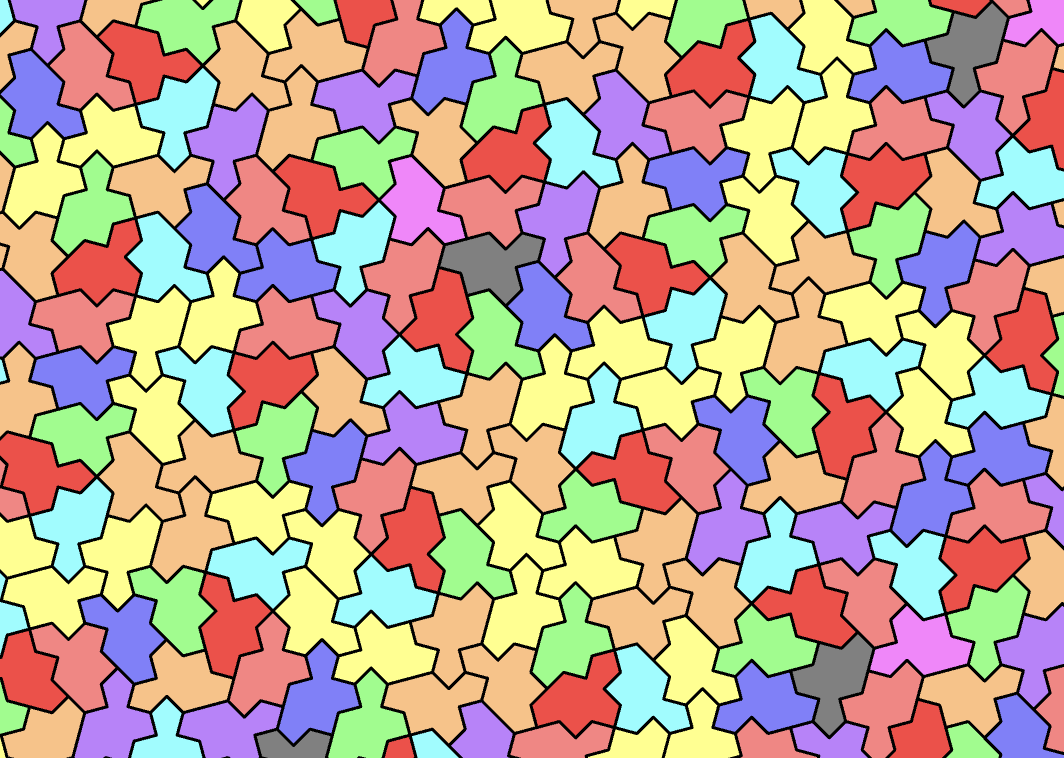
In 2023, a team (David Smith, Joseph Myers, Craig
Kaplan, and Chaim Goodman-Strauss) constructed a single tile (the "Spectre")
that tiles the plane but only aperiodically.
Quasicrystals
Penrose tilings can make patterns with many types of rotational symmetry.
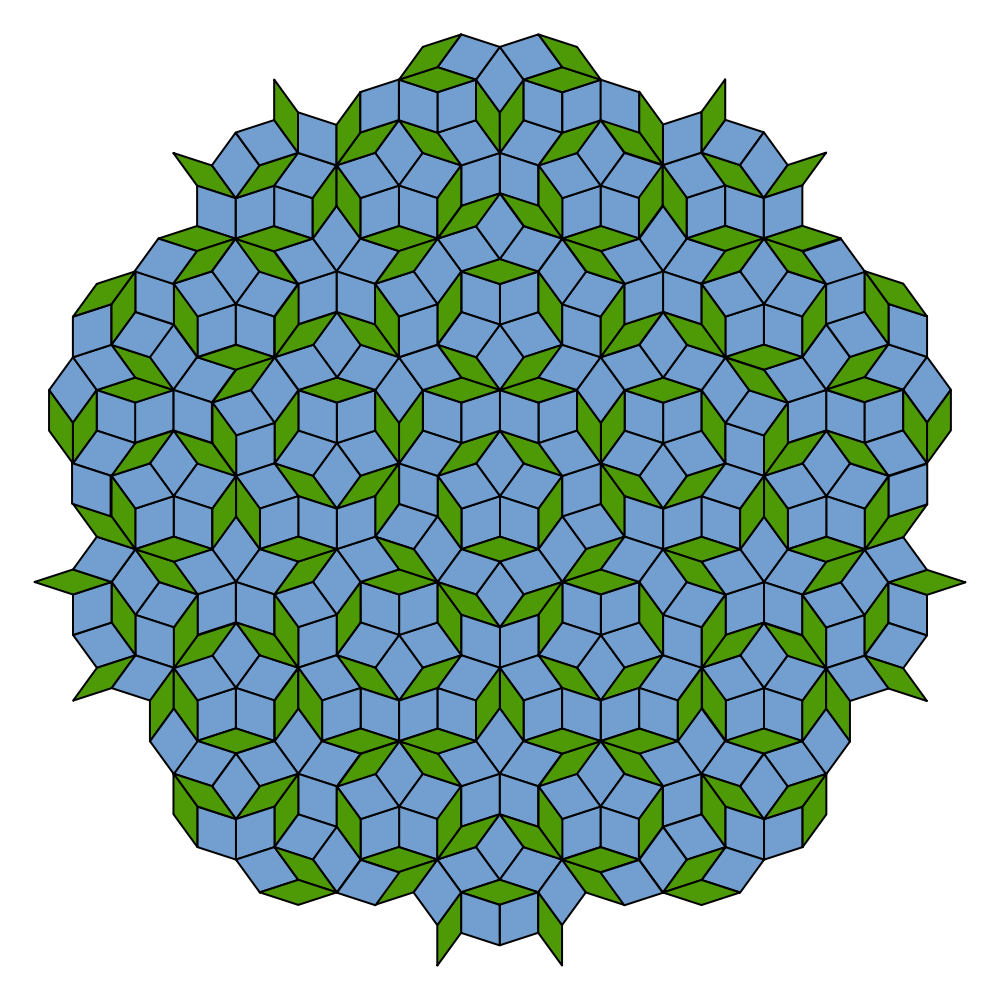
5-fold symmetry
from Wikipedia
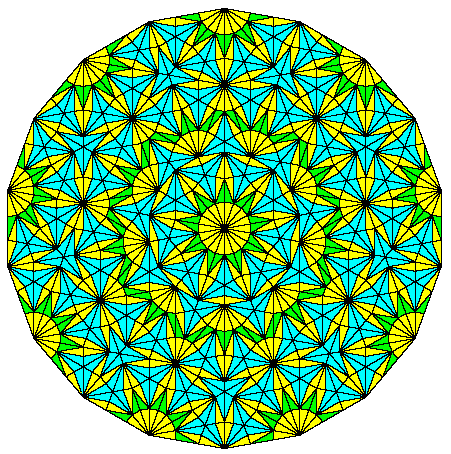
9-fold symmetry
from Kevin Brown, The Math Pages
Classical chemical crystal structures produce only four types of
rotational symmetr: 2-fold, 3-fold, 4-fold, and 6-fold.
In 1982, a chemist named Dan Shechtman observed a crystal structure with
a 5-fold rotational symmetry, in an alloy of manganese and aluminum.
These were eventually named "quasicrystals".
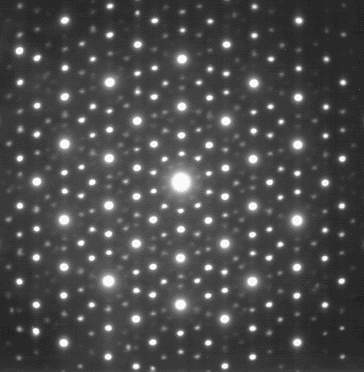
At first, this discovery was not well received.
"Danny, you are a disgrace to my group. I cannot be with you in the same group."
Head of Shechtman's lab at NIST
"Danny Shechtman is talking nonsense, there are no quasi-crystals, just quasi-scientists."
Linus Pauling
However, other folks replicated his observations.
- In 2008-2011 Luca Bindi and Paul Steinhardt tracked down natural examples of quasicrystals.
- In 2011, Shechtman was given the Nobel prize in Chemistry.
More information on tilings
Some good Wikipedia articles:
From others: