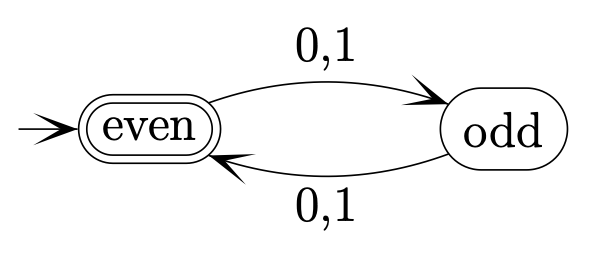
Suppose that our set of input characters contains 0 and 1. Let's build DFAs to recognize two simple patterns: even length strings and strings that have exactly the form $1(00)^+1$

In this second example, notice that there are certain places where seeing one of the two characters immediately means the input string isn't acceptable, e.g. seeing a 0 as the first character or a 1 as the second character. To keep the diagram simple, we simply omit the transitions for these inputs and have the convention that missing transitions lead to a "dump" (aka fail) state.
Similarly, there are no transitions from the final state E. Our string isn't supposed to contain any characters after that second 1. So there are implied transitions from E to the dump state on both 0 and 1.
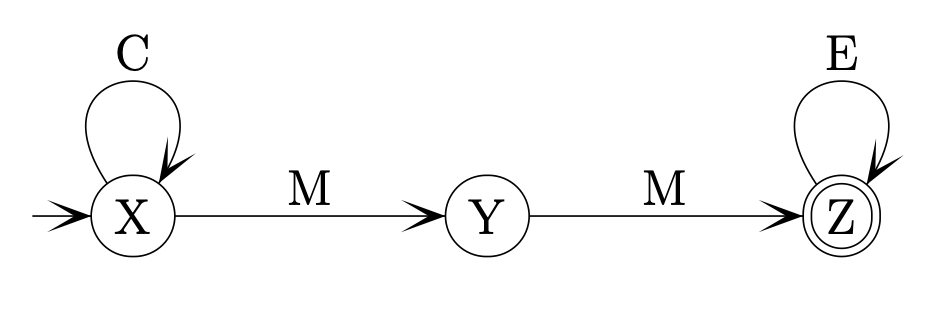
Suppose that our set of input characters contains C, E, and M. Let's build a DFA that recognizes strings of even length that have the form $C^*MME^*$. (Remember that $x^*$ means zero or more x's.)
We can use the following state diagram to recognize $C^*MME^*$, where missing transitions go to an invisible dump state.
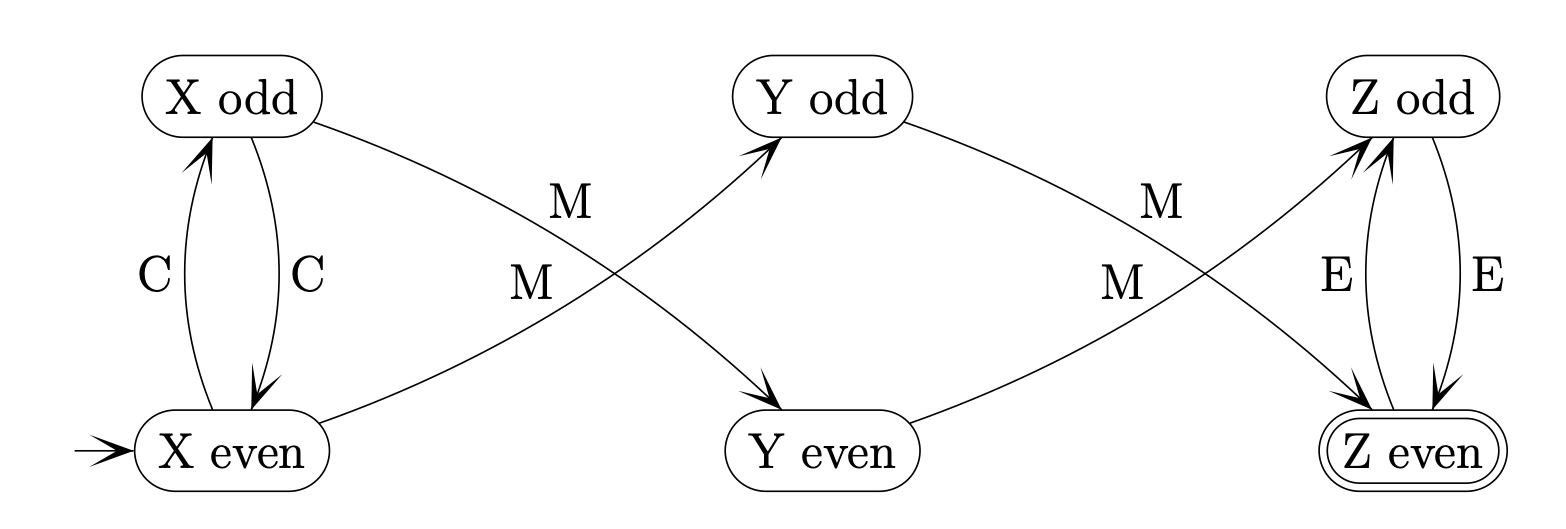
Let's modify that state diagram so that it also keeps track of whether the overall length is even or odd. To do this, we make two copies of each state.
We want to build a DFA that will recognize if the string WYSWYG appears anywhere in a sequence of characters. For simplicity, let's assume that no other characters will appear except these four.
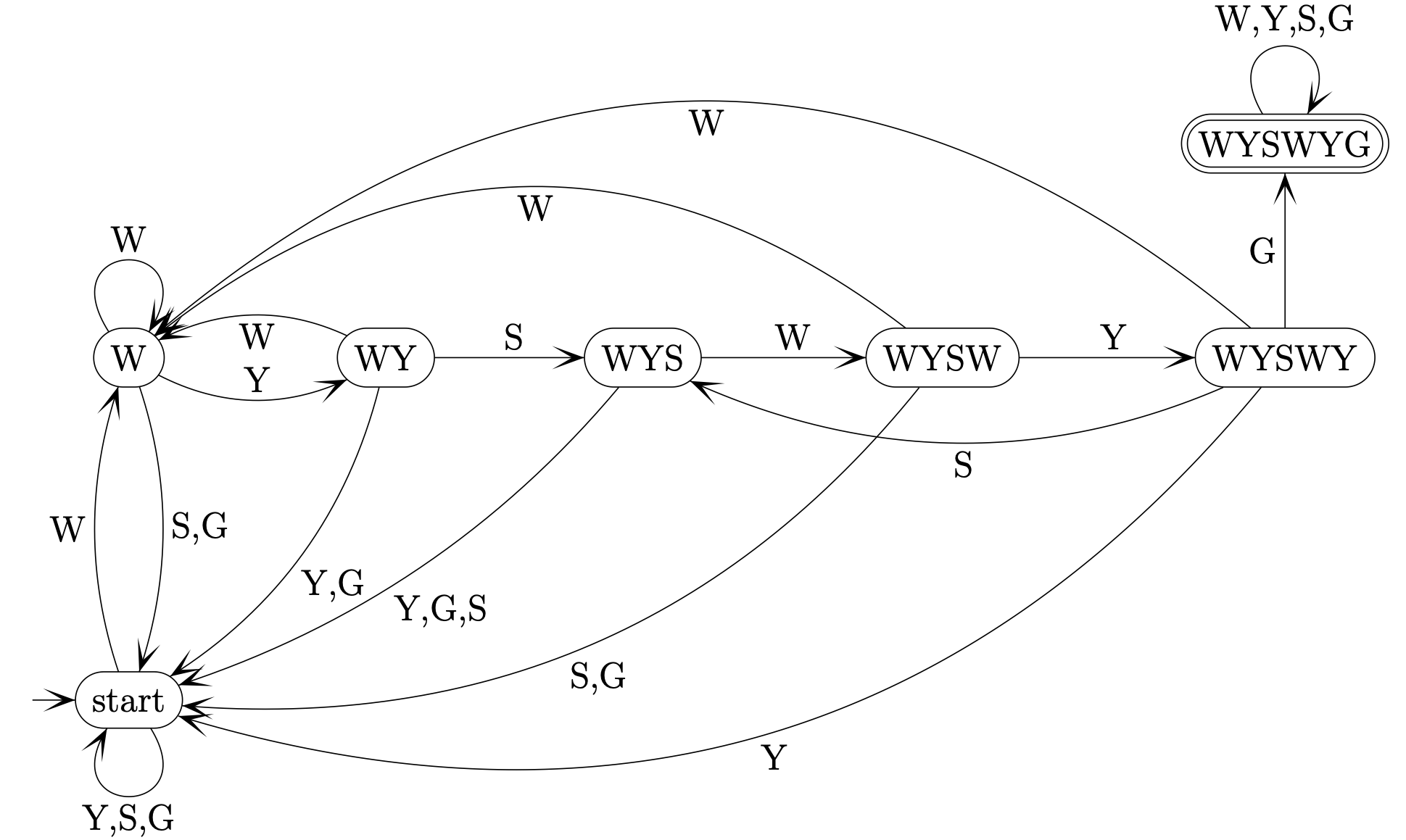
DFA for WYSWYG.
To extend this to handle inputs that might containadditional characters besides these four, put the other possible characters on the transitions headed back to the start state.