ECE 537 Speech Processing Fundamentals
Development of an intuitive understanding of speech processing by the auditory system, in three parts. I): The theory of acoustics of speech production, introductory acoustic phonetics, inhomogeneous transmission line theory (and reflectance), room acoustics, the short-time Fourier Transform (and its inverse), and signal processing of speech (LPC, CELP, VQ). II): Psychoacoustics of speech perception, critical bands, masking (JNDs), and the physiology of the auditory pathway (cochlear modeling). III): Information theory entropy, channel capacity, the confusion matrix, state models, EM algorithms, and Bayesian networks. Presentation of classic papers on speech processing and speech perception by student groups.
Pre-Requisites: Signal Processing (ECE 310, 401, or equivalent) and Random Variables (ECE 313, CS 361, STAT 410 or equivalent)
Instructor: Mark Hasegawa-Johnson (jhasegaw)
Recommended Textbook: Theory and Applications of Digital Speech Processing, 1st Edition by Rabiner and Schafer
Contents:
On-line Tools
CampusWire will be used for on-line question answering. If you need the code to enter this site, send an e-mail to the course instructor.
Gradescope will be used for homework, exams, project proposal, and project writeup.
Mediaspace will have videos of past lectures. Lectures will be transmitted in realtime at the Zoom URL shown on our CampusWire.
There will be two mid-terms. Instead of a final exam, there will be a final project.
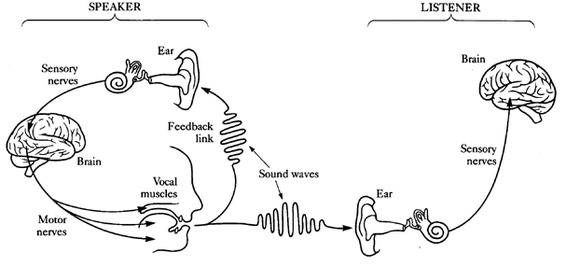
Our logo this semester is Figure 1.1 from the classic 1963 textbook The Speech Chain by Peter Denes and Elliot Pinson.
Grades
Grade cutoffs will be approximately 90% for A-, 75% for B-, 60% for C-. Your cumulative score for the semester is a weighted sum of component scores, with the following weights:
37.5%: Homework assignments 1-6
12.5%: Two in-class paper presentations
50%: Final Project
All homework assignments and exams require that you succinctly explain the reasoning behind your answer; answers presented without reasons are considered incomplete. You may ask AI for help on homework but not exams. Homework with minor errors will receive full points. Homework written in a steretypically AI-like manner may not receive full points. Any homework assignment may be turned in late, with a penalty of 5%.
Extra credit of up to 1% is available for correctly answering the questions of other students on CampusWire. Extra credit of up to 6.25% is available for doing the optional homework assignment HW7.