Which of the following statements are true?
Answers:
Let \(f: \mathbb{Z}^2 \rightarrow \mathbb{Z}\) such that \(f(x,y) = 4x + 3y\)
Claim: f is onto
A function \(f:A\rightarrow B\) is onto if and only if
For every k in B, there is a value j in A such that f(j) = k.
So our specific function f is onto if and only if
For every integer k, there is a pair of integers \((x,y)\) such that f(x,y) = 4x + 3y = k.
On scratch paper
How to get 7 as output? input (1,1)
How to get 1 as output? input (1,-1) or (-2,3) or ....
How to get k as output? input (k, -k) or (-2k, 3k) or ...
For the proof, pick one way to find the pre-image of an output value k. Let's use (-2k, 3k).
Proof:
Let \(k \in \mathbb{Z}\).Consider \((-2k,4k) \in \mathbb{Z}^2\).
\(f(-2k,3k) = 4(-2k) + 3(3k) = -8k + 9k = k\). So \((-2k,3k)\) is a pre-image of k.
Since k was arbitrarily chosen, this means that every integer k has a pre-image. So f is onto.
Let \(g:\mathbb{Z} \rightarrow \mathbb{Z}\) be one-to-one.
Let \(f:\mathbb{Z} \rightarrow \mathbb{Z}^2\) such that \(f(x) = (g(x)|x|, |x|)\).
Prove that f is one-to-one.
A function \(f: A \rightarrow B\) is one-to-one if
Proofs normally use the second form.
Slightly buggy proof:
Let \(x\) and \(y\) be integers. Suppose that \(f(x) = f(y)\).By the definition of \(f\), this means that \((g(x)|x|,|x|) = (g(y)|y|,|y|)\).
So \(g(x)|x| = g(y)|y|\) and \(|x| = |y|\).
So \(g(x)|x| = g(y)|x|\).
Dividing the this equation by \(|x|\), we get \(g(x) = g(y)\).
Since g is one-to-one, this implies that x = y, which is what we needed to prove.
Ooops: what happens if \(x=y=0\)?
Correct proof
Let \(x\) and \(y\) be integers. Suppose that \(f(x) = f(y)\).By the definition of \(f\), this means that \((g(x)|x|,|x|) = (g(y)|y|,|y|)\).
So \(g(x)|x| = g(y)|y|\) and \(|x| = |y|\).
There are two cases:
Case 1: \(|x| = 0\). So \(x = 0\). Since \(|x| = |y|\), \(y\) must also be zero. So \(x= y\).
Case 2: \(|x| \not = 0\). Since \(g(x)|x| = g(y)|y|\) and \(|x| = |y|\), we have \(g(x)|x| = g(y)|x|\).
Dividing this equation by \(|x|\), we get \(g(x) = g(y)\). Since g is onto, this implies that \(x = y\).
In both cases, \(x=y\), which is what we needed to prove.
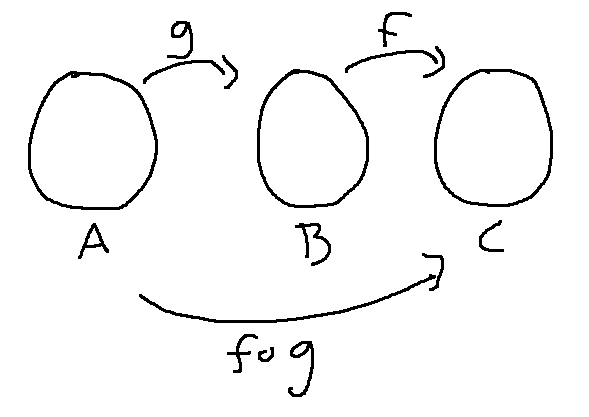
Claim: For any sets A, B, and C, and any functions \(g: A\rightarrow B\) and \(f: B\rightarrow C\), if \(f \circ g\) is one-to-one and g is onto, then f is one-to-one
What does this even mean and why do I think it's true?
Recall: \((f \circ g)(x) = f(g(x)) \)
Bubble diagram for keeping track of what's going on:
Long ago, ten CS theory faculty played World of Warcraft and each one had an avatar. Jeff Erickson's avatar \(e_J\) might have been an elf with a purple braid. We can model this with two functions:
g:{CS theory faculty} \(\rightarrow\) {World of Warcraft avatars}
f: {World of Warcraft avatars} \(\rightarrow\) {hairstyles}
Let's say each theory faculty member had an avatar with a different hairstyle. Then \(f \circ g\) would be one-to-one.
But there were about 10 million World of Warcraft subscribers and only about 3000 hairstyles. So some avatars must have shared hairstyles. So f can't be one-to-one.
Here's the picture if Michelle Obama was also playing as an elf (\(e_M\)) with the same purple braid as Jeff's avatar.
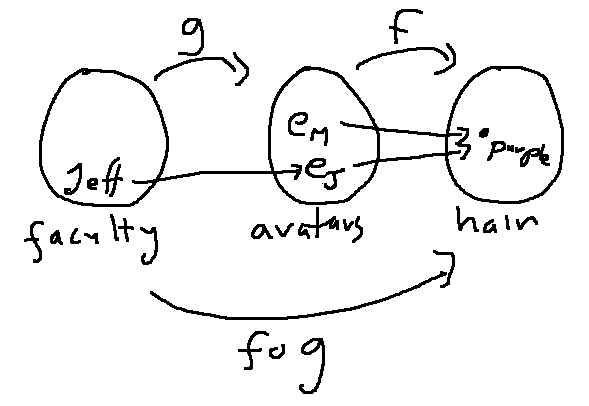
So our claim won't work unless g's outputs cover all of B.
Pick \(x\) and \(y\) from B. Suppose \(f(x) = f(y)\). We need to show that \(x=y\).
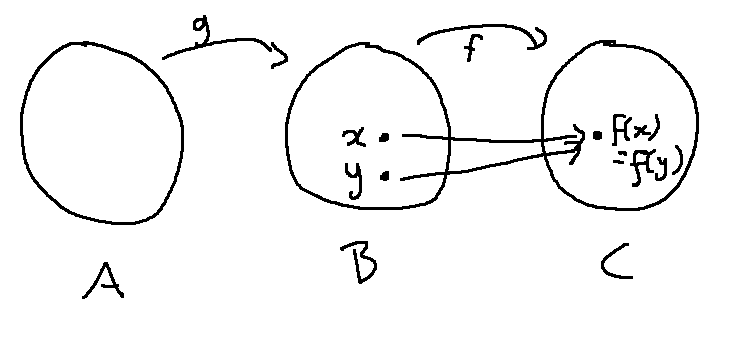
\(g\) is onto. So we have pre-images for \(x\) and \(y\). \(g(p) = x\) and \(g(q) = y\).
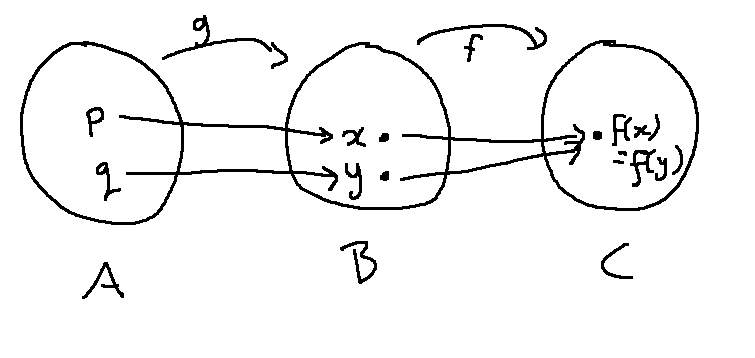
Since \(f \circ g\) is one-to-one:
\((f \circ g)(p) = f(g(p)) = f(x)\)
\((f \circ g)(q) = f(g(q)) = f(y)\)
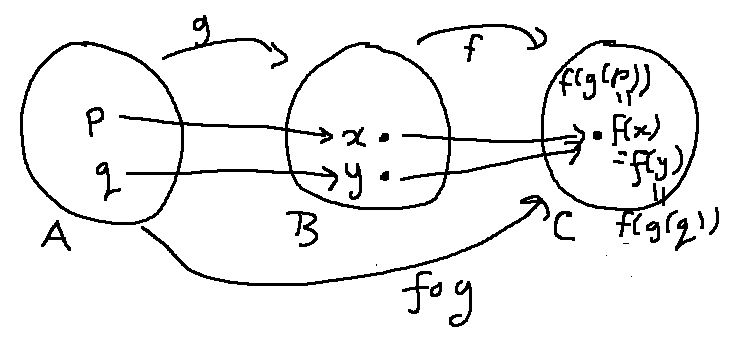
Since we know \(f(x)= f(y)\), we have \((f \circ g)(p) = (f \circ g)(q)\).
Since \((f \circ g)\) is one-to-one, this means \(p=q\) and therefore \(x=y\).
Proof:
Let \(A\), \(B\), and \(C\) be sets and suppose that \(g: A\rightarrow B\) and \(f: B\rightarrow C\) are functions. Also suppose that \(f \circ g\) is one-to-one and g is onto.Let \(x\) and \(y\) be elements of \(B\). Suppose that \(f(x) = f(y)\). We need to show that \(x = y\).
Since \(g\) is onto, there are \(p\) and \(q\) in \(A\) such that \(g(p) = x\) and \(g(q) = y\).
\((f \circ g)(p) = f(g(p)) = f(x) = f(y) = f(g(q)) = (f \circ g)(q)\)
So \((f \circ g)(p) = (f \circ g)(q)\). Since \(f \circ g\) is one-to-one, this means that \(p=q\).
Since \(p=q\), \(g(p) = g(q)\). So \(x = g(p) = g(q) = y\). So \(x = y\).
We've shown that \(f(x) = f(y)\) implies that x=y. So f is one-to-one. \(\Box\)