A set $S$ is countably infinite if there is a bijection between $S$ and the natural numbers. We can show this in two ways:
A set is countable if it's either finite or countably infinite.
Intuitively:
Example
finite decimal: 3.225
repeating decimal: \(7.5\overline{358}\)
repeating decimal in programming-style notation: 7.5{358}
Irrational numbers have a decimal representations that goes on forever, without a repeating pattern.
Other examples of countable sets include
See details and proofs in textbook. We'll just do one example.
Suppose that M is the set of all 26 uppercase letters. Recall that \(M^*\) is the set of all finite-length strings made from characters in M, including the empty string (\(\epsilon\)).
Claim: \(M^*\) is countably infinite (and thus countable).
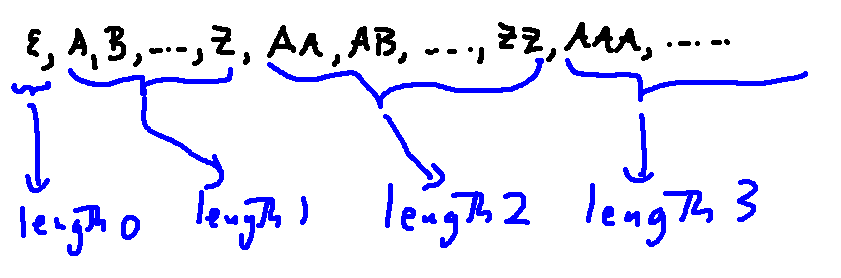
We can put all strings from \(M^*\) into an order, indexed by the integers:
With a bit of work, you could figure out where each length group starts and exactly how to compute the position of any input string.
So this gives us a bijection between \(M^*\) and \(\mathbb{N}\).
We could also construct one-to-one functions in both directions.
Part 1: make a one-to-one function f from \(\mathbb{N}\) to \(M^*\).
One choice is to let f map each natural number n into a string of n A's. For example \(f(0) = \epsilon\), $f(2) = \texttt{AA}$, and $f(8) = \texttt{AAAAAAAA}$.
This function is very far from being a bijection, but it's definitely one-to-one.
Part 2: make a one-to-one function g from \(M^*\) to \(\mathbb{N}\).
To construct g, we're going to map each letter into a 2-digit code.
| A | B | C | ... | I | ... | U | ... | Z |
| 65 | 66 | 67 | ... | 73 | ... | 85 | ... | 90 |
If s is a string of letters, we'll make g(s) by concatenating the letter codes. E.g. g("UIUC")=85738567. Because the codes are all exactly two digits, we can easily decode one of these output numbers to get the input string that generated it. So g is one-to-one.
We need a special value for \(g(\epsilon)\). One possible choice is \(g(\epsilon) = 0\).
Summarizing
So by the Cantor-Schroeder-Bernstein Theorem, \(|M^*| = |\mathbb{N}|\). So \(M^*\) is countably infinite.
Now let's prove that there are uncountable sets.
Claim: the set of all infinite binary sequences (aka infinite bit vectors) is uncountable.
We'll use a trick called "diagonalization" due to Georg Cantor.
Proof: suppose not. That is suppose that the set of infinite binary sequences is countable. That means that we can put all infinite binary sequences into a list indexed by the natural numbers: \(S_0, S_1, S_2, \ldots\).
| $b_0$ | $b_1$ | $b_2$ | $b_3$ | $b_4$ | $b_5$ | $b_6$ | $b_7$ | $b_8$ | $b_9$ | $\ldots$ | |
|---|---|---|---|---|---|---|---|---|---|---|---|
| $S_0$ | 1 | 1 | 0 | 1 | 1 | 0 | 1 | 1 | 1 | 1 | $\ldots$ |
| $S_1$ | 1 | 1 | 0 | 0 | 1 | 0 | 1 | 1 | 0 | 0 | $\ldots$ |
| $S_2$ | 0 | 0 | 0 | 0 | 1 | 0 | 0 | 1 | 0 | 0 | $\ldots$ |
| $S_3$ | 0 | 1 | 1 | 1 | 1 | 0 | 1 | 0 | 0 | 0 | $\ldots$ |
| $S_4$ | 0 | 0 | 0 | 0 | 1 | 1 | 1 | 0 | 1 | 1 | $\ldots$ |
| $S_5$ | 1 | 1 | 1 | 0 | 1 | 0 | 1 | 0 | 0 | 1 | $\ldots$ |
| $\ldots$ | $\ldots$ | ||||||||||
Now, let's make a new infinite bit vector X from the values on the diagonal of this chart. That is \(X(k) = S_k(k)\).
| $b_0$ | $b_1$ | $b_2$ | $b_3$ | $b_4$ | $b_5$ | $b_6$ | $b_7$ | $b_8$ | $b_9$ | $\ldots$ | |
|---|---|---|---|---|---|---|---|---|---|---|---|
| $S_0$ | 1 | 1 | 0 | 1 | 1 | 0 | 1 | 1 | 1 | 1 | $\ldots$ |
| $S_1$ | 1 | 1 | 0 | 0 | 1 | 0 | 1 | 1 | 0 | 0 | $\ldots$ |
| $S_2$ | 0 | 0 | 0 | 0 | 1 | 0 | 0 | 1 | 0 | 0 | $\ldots$ |
| $S_3$ | 0 | 1 | 1 | 1 | 1 | 0 | 1 | 0 | 0 | 0 | $\ldots$ |
| $S_4$ | 0 | 0 | 0 | 0 | 1 | 1 | 1 | 0 | 1 | 1 | $\ldots$ |
| $S_5$ | 1 | 1 | 1 | 0 | 1 | 0 | 1 | 0 | 0 | 1 | $\ldots$ |
| $\ldots$ | $\ldots$ | ||||||||||
Now let's define a vector Y that has exactly the opposite bit values as X. That is $Y_k = 1$ if and only if $X_k$ = 0.
Suppose we pick any vector \(S_k\) on the list. Then Y and \(S_k\) have different values at position k. That means that Y can't be any of the vectors in our list \(S_0, S_1, S_2, \ldots\).
So we have a contradiction, because our list was supposed to have contained all the binary sequences. Therefore, we must have been wrong in our assumption the set was countable.
Ways to interpret a bit vector
Bit vector representation of a set containing 0, 1, 5, 6, and 9, but not 2, 3, 4, 7, 8, 10, 11.
| number | 0 | 1 | 2 | 3 | 4 | 5 | 6 | 7 | 8 | 9 | 10 | 11 | ... |
|---|---|---|---|---|---|---|---|---|---|---|---|---|---|
| in set? | 1 | 1 | 0 | 0 | 0 | 1 | 1 | 0 | 0 | 1 | 0 | 0 | ... |
So
We can modify diagonalization to show that the real interval $[0,1]$ is uncountable. Short story: write the fractional parts as decimals. To make the vector Y, change diagonal digits to 5, except change 5 to 4.
So
Beware: these sets are countable
Diagonalization can be done using any set to index the list. So
\(\mathbb{P}(\mathbb{N})\) is uncountable. However, suppose we define a set A to be the set of all finite subsets of \(\mathbb{N})\). Then A is countable for the same reason that \(M^*\) (finite length strings) is countable.
Intuitively, the difference between A and \(\mathbb{P}(\mathbb{N})\) is that each subset in A has a finite representation, e.g. as a finite-length string of 0's and 1's. Some (actually most) of the subsets in \(\mathbb{P}(\mathbb{N})\) have only infinite-length representations.