A computer is something that performs computations. In arithmetic classes, you learn to be a computer. Prior to the 1970s, some people were professional computers, solving mathematical expressions for other people.
A computing machine is a computer that is a device, not a person. There are many devices that could be argued to be computing machines, ranging from bags and boxes that can perform addition (pour one into another to find the sum of the things in them) to specialized electrical circuits that perform integration. Most of these, however, would not be called computers because the computation they perform is fixed at the time the machine is constructed.
A programmable computer accepts two kinds of inputs: the arguments or input values to compute a result based on and instructions describing what specific computations to perform on those arguments.
When you are presented with an arithmetic expression like you are getting both instructions (in the form of the operators , , , and and the order in which they appear) and arguments (in the form of the values , , , , and and the results of intermediate computations you perform).
A digital computer represents both its arguments and the results it produces using digits, not analogs. Analog signals represent a single value by another single value, while digital signals represent it by a formalism known as place-value numbers.
If you decided to hum with the volume of your hum analogous to your net worth and the pitch of your hum analogous to how quickly that net worth was changing, then
Wealthy people would hum more loudly than broke people.
People earning money would hum higher notes than people spending money.
These are analog signals: a signal being communicated is matched by an analogous signal.
If you decided to share your net worth using the Latin version of Arabic base-10 digits, you might say something like 102.26. That’s six distinct signals (1, ,, 0, and so on to 6) no one of which is analogous to your net worth, but when put together using special rules we learned as children the represented value can be recovered.
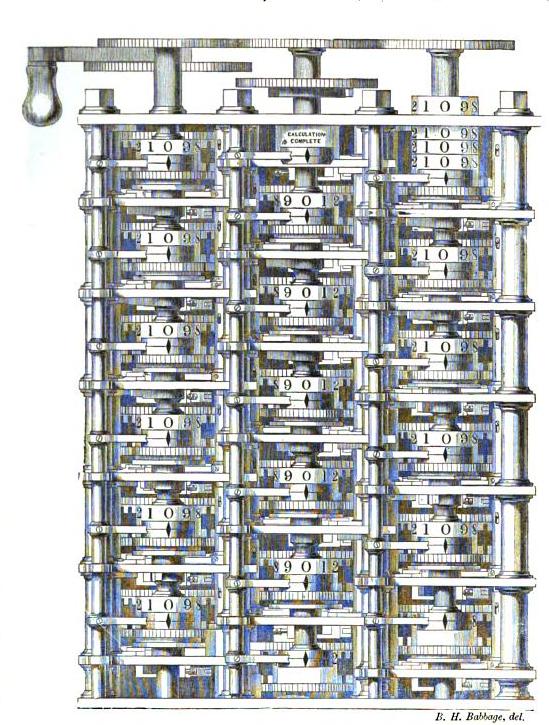
Charles Babbage’s Difference Engine, the first programmable digital computer
A portrait of Charles Babbage, circa 1820, by an unknown artist. Public domain, hosted by Wikimedia
In 1822, Charles Babbage built a clockwork machine for computing various polynomial expressions which he called a Difference Engine, and designed several larger versions for computing larger expressions to more digits of precision. This is generally cited as the first programmable digital computer.
A print of a drawing of Charles Babbage’s engine by his eldest son, Benjamin Herschel Babbage. Public domain, hosted by Wikimedia
Charles Babbage was trained in mathematics and worked in a variety of fields, including economics, management, theology, meteorology, medicine, mechanical engineering, and cryptography. Arguably his most impactful invention during his own lifetime was a metal frame to attach to the front of locomotives to clear the track of obstacles such as grazing cattle.
If a programmable digital computer uses the same media for storing instructions, arguments, and the results of computations; and if it is of specific limited by versatile set of computations; then it becomes a general purpose programmable computer. General-purpose computers can do dramatically more than other computers because they can use the operations they were built to perform to define other types of operations.
Ada Lovelace, the first general-purpose programmer
A photograph of Ada Lovelace by Antoine Claudet, 1843. Public domain, hosted by Wikimedia
Augusta Ada King née Byron, Countess of Lovelace, observed Charles Babbage’s difference engine and understood its potential in a way that Babbage himself did not. Babbage was intent on building what we’d now think of as a calculator: a tool for computing the value of polynomials at various arguments to solve arithmetic problems that arose in various contexts. Ada Lovelace understood that, while the machine he’d built was limited to those arithmetical tasks, with some adjustments a general-purpose version might be built. Working with Babbage, she helped design the Analytical Engine which would have been the first general-purpose programmable digital computer had it been built.
The Analytical Engine was not completed because its original backers, the British government, did not think it was worth the cost. In 1842 the British Prime Minister, Sir Robert Peel, is recorded1 In Additional Manuscript 40,514 folio 223 in the British Library. to have said
What shall we do to get rid of Mr. Babbage and his calculating Machine? Surely if completed it would be worthless as far as science is concerned?
Historians debate whether it was Charles or Ada who wrote the first computer program; both programs are recorded, but the relative dates of the two is unclear.
An example of her understanding of the potential of this yet-unbuilt machine can be found in her 1842 submission to the journal Scientific Memoirs:
Supposing, for instance, that the fundamental relations of pitched sounds in the science of harmony and of musical composition were susceptible of such expression and adaptations, the engine might compose elaborate and scientific pieces of music of any degree of complexity or extent.
Ada Lovelace’s background in mathematics that prepared her to make these discoveries was gained as part on her mother’s efforts to distance her from her father, Lord Byron, who was known for writing romantic poetry and for pursuing sexual relations with many people, both men and women, both single and married, including some of his own cousins.
The Church-Turing Thesis states that there are mathematical languages and physical machines that are capable of doing anything that can be done with information. That’s quite the claim: we can build one machine, design one mathematcal language, and do anything with it. We can’t prove that claim (because we can’t define everything well enough to include in a proof), but so far we have not found any counter-examples.
We call things that can do any information task Turing complete. The first two things to be shown to be Turing complete were the Turing Machine and the Lambda Calculus; others include all major programming languages and all general-purpose programmable computers2 At least, it would include these if they had unlimited memory and time; but since they don’t, there are tasks that are too big for them to complete..
Church and Turing
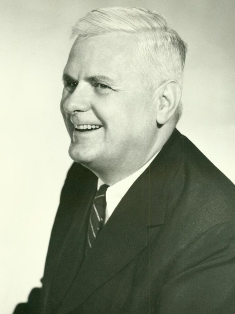
A Princeton University faculty member portrait of Alonzo Church, taken later in his life. Fair use, hosted by Wikipedia
Alonzo Church was the son of a judge and the grandson of a mathematics professor who both attended and spent most of his career working at Princeton University as a professor of mathematics and philosophy.
A photograph of Alan Turing taken 29 March 1951. Public domain, hosted by Wikimedia
Alan Turing was the son of a British administrator in India and grandson of both a clergyman and a railway chief engineer. He traveled between England and India often as a child and sometimes stayed at a friend of the family’s home or at a boarding school when his parents traveled. He was recognized early as a genius with diverse interests, but a particular interest in Mathematics. He studied at Cambridge and then Princeton, being one of Alonzo Church’s doctoral students.
Church was interested in a branch of Mathematics related to the fundamental limitations of mathematical systems. A recent proof by Kurt Gödel showed any sufficiently complicated mathematical system could express a version of the statement this statement cannot be proven true, which was self-evidently true only if it was unprovable, demonstrating that such languages could express true but unprovable things. But Kurt Gödel’s version of that was a fairly complicated mathematical construct in a very large mathematical system.
Church was interested in converting Gödel’s work into much simpler systems. He designed a very small mathematical system which could still express that idea, which he called the lambda calculus. His student Alan Turing came up with a simple machine design, the operation of which tightly paralleled what the lambda calculus could do, which was later termed the Turing machine. The two them postulated, but did not prove, that any more-complicated mathematical system could be reduced to the Lambda calculus and any more-complicated machine could be reduced to the Turing machine. This concept that the two were capable of doing anything that other systems could do is called the Church-Turing Thesis.
After publishing their thesis, Alonzo Church spent several more decades teaching at Princeton, then at the University of California at Los Angeles, publishing many additional papers in mathematics and philosophy. He was generally regarded as a quiet and focused person and did little to attract attention outside his academic work.
Alan Turing returned to England and worked on cracking German codes during World War II. Shortly after the war ended he was convicted of homosexual acts (then illegal in England) and sentenced to involuntary hormone injection and limitations on his freedom of movement. Three years later he was found dead of cyanide poisoning, though it is not clear if this was suicide, murder, or an accidental exposure due to a chemistry experiment he was undertaking in his spare room.
With the above understanding of general-purpose computers, we can distinguish between three key concepts:
Hardware
The physical machinery of the computer.
Firmware
Instructions provided to a programmable computer in durable form, such as and arrangement of physical switches or in their electronic equivalent.
Software
Instructions provided to a programmable general-purpose computer in mutable form, using the same medium as is used for arguments and results.
This also helps us distinguish between several computing professions:
Computer Engineers
Primarily consider the design of hardware.
Computer Scientists
Primarily consider the scope, possibilities, and limitations of software.
Software Developers
Create software.
Software Engineers
Create large-scale software using engineering principles: understanding both the problem space and the constraints under which the software is to be developed, then using orderly process to design and create software that solves those problems subject to those constraints.
Information Technology
A broad term, not always used in the same way.
One common use is for the people who procure, install, integrate, and maintain hardware and software purchased from others.
Another common use is as an umbrella term for all the professions in this list.